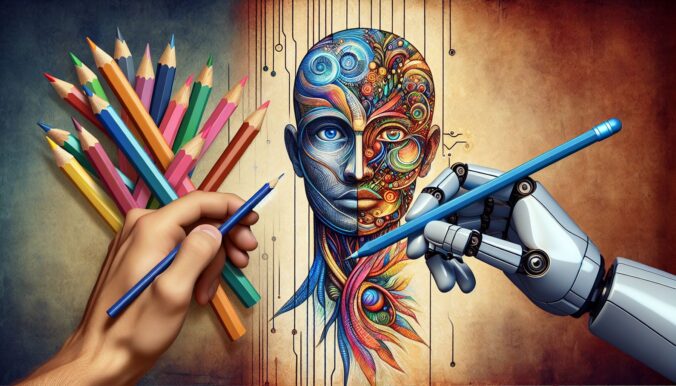
Hey tech aficionados and future explorers! Today we’re diving into a topic that’s got the creative crowd buzzing and computational minds whirring—Artificial Intelligence in creative arts. It’s where algorithms meet artistry, and I promise, it’s as fascinating as it sounds. Grab a coffee, lean back, and let’s talk about how AI is changing from a data-crunching beast to a painter, musician, and scriptwriter. Trust me, it’s a ride worth taking!
The Art of A.I.: From Data to DaVinci
Let’s get one thing straight, folks. AI isn’t just about number-crunching and logic-heavy algorithms. When it starts playing with colors, notes, and dialogues, we’re talking a whole new ballgame. Think of AI like that precocious kid in art class—it’s got potential, but it’s still scribbling outside the lines.
Bots with Brushstrokes
Remember the first time you saw an AI-generated artwork? Maybe it was a landscape that felt surprisingly human or a portrait with eyes so deep that they seemed to speak to you. That’s no accident. Behind the scenes, AI models like Generative Adversarial Networks (GANs) work their magic, learning aesthetics by processing thousands of images and then creating something uniquely new. It’s like teaching a toddler to paint by showing them every masterpiece in the Louvre—except this toddler churns out a pretty decent Picasso on a whim.
AI’s move into art hit a major milestone when an algorithm’s painting, “Edmond de Belamy,” sold at auction for a cool $432,500. Yes, you read that right. It’s like watching your Roomba earn more in one night than you will in a lifetime. Unlike your typical AI-does-abstract-art accident, this one was a deliberate creation, and art collectors couldn’t get enough.
Melodies Born from Mathematics
Now, if you’re more of a Beethoven than a Botticelli, don’t worry. AI has dipped its silicon fingers into music too! A program helping write a pop song? Totally happening. I can already see purists balking but hear me out. Even David Bowie jammed with tech in his time. Today, platforms like Jukedeck or OpenAI’s MuseNet are scoring tunes that range from catchy background music to orchestral scores.
These AI compositions won’t break Spotify yet, but they do add a layer to how we think about musical creativity. Who knows? Maybe the next Grammy award winner collabs with a non-human composer. Imagine: “and the award goes to… DJ Algorithm ft. Daft Punk!”
Behind the Curtain: How AI Gets Creative
You’re probably wondering, “How on Earth does it pull this off?” It’s all about using sophisticated models that learn from human inputs and outputs. Neural networks mimic brain pathways, allowing them to “learn” creativity from centuries of human artistry.
The Tech that Tugs at Emotions
At the heart of AI’s artistic pursuits are deep learning algorithms—those brain-inspired frameworks that don’t sleep, don’t eat (obviously), and far outpace human learning capabilities. They’re fed datasets containing exhaustive details of artistic styles, musical notes, literary tones—you name it—to develop a sophisticated ‘understanding’ of what makes something inherently ‘artistic’.
To put it simply, AI is less about creating art in a traditional sense and more about sorting through possibilities. It’s like giving your grandma an iPad and watching her discover Pinterest—mind-blowing, but with a few moments of confusion.
From Studio to Stage: The Implications of AI in the Arts
Our world is changing, and in this realm, the changes could be huge. Are you imagining a world where robots sit in directors’ chairs and tune their guitars before a televised debut? The future’s not far off.
Leveling the Playing Field
First, AI democratizes access to creativity, allowing people with no traditional training in art or music to experiment and produce high-quality content. Even startups and indie artists can now afford to leap into this realm with all cylinders firing. Increased access means more voices—it’s like discovering your voice at a karaoke bar, but the whole world gets to jam in.
The Age-Old Debate: Artist vs. Machine
Yet, there’s that inevitable question: Is art losing its essence when it comes from an algorithm rather than a human soul? My take—why does it need to be a ‘versus’? Why not both? Collaboration can breed entirely new forms of emotional experiences, much like fusion cuisine melds flavors from different culinary traditions to create something deliciously unfamiliar.
The Road Ahead (Or, “Where Do We Go From Here?”)
While AI in the arts is still largely experimental, we’re starring in a movie where each act gets more eye-opening. Yet challenges remain: copyright issues, ethical dilemmas about fair attribution, and of course, the eternal philosophical debate—what counts as true creativity?
The Speculative Crystal Ball
In true fortune-teller fashion, here’s what I think is coming: AI will become the paintbrush of future Picassos, the quill for modern-day Shakespeares, and maybe an electric violin in a symphony made of silicon and cells. But the human touch will never fade away. AI is a tool, not a replacement. It adds color, it adds texture, but it’s ultimately still in our hands to create the masterpiece.
As AI moves deeper into the creative arts, hold on to your hats because it’s going to be one wild, beautiful, algorithmically-enhanced ride. Don’t be surprised when your next gallery tour features a robot masterpiece, or when The Grammys go to DJ Algorithm. The stage is big enough for all. After all, life’s a rich canvas and the palette just got a whole lot bigger.
Now, let me know if anyone’s interested in starting a tech-driven band! We’ll call it “The Logical Bards.” See you in the future, filled with boundless creativity and a sprinkle of silicon magic!