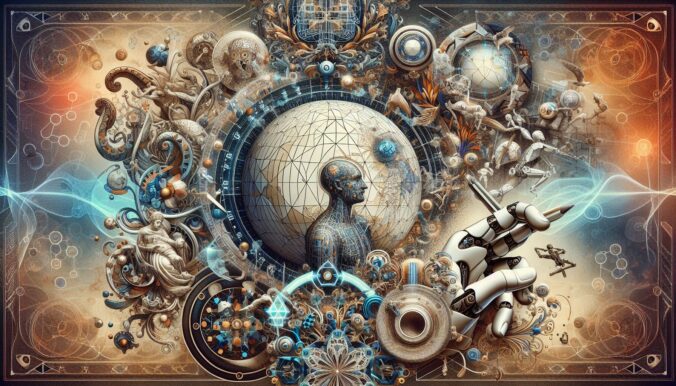
Hey, tech enthusiasts and creative dreamers! Today I want to chat about something that’s been tickling the back of my brain and my creative bones—AI in the creative arts. With AI painting canvases, composing symphonies, and writing halfway decent poetry, I can’t help but wonder: Are we on the verge of a new creative renaissance, fueled by silicon and code? So, grab your virtual beret and let’s explore this fascinating intersection between what’s traditionally human and a futuristic assistant we all saw coming.
AI: Not Just for Number Crunchers Anymore
Remember when AI was just a fancy term for algorithms plodding through giant data sets faster than you could say “Moore’s Law”? Yeah, those days are long gone. AI is stepping out from behind the spreadsheets and into the wild, wonderfully unpredictable world of human creativity. I mean, who would’ve thought that an AI could compose a symphony as complex as something out of Beethoven’s sketchbook or create arrestingly beautiful art pieces? It’s not just sci-fi anymore; it’s happening.
The Techy Brush: AI in Visual Arts
So, let’s talk about the wild brushwork AI is producing these days. Applications like DALL-E are transforming simple text descriptions into vivid and sometimes jaw-dropping images. (I dare you to look away after inputting “chimera skateboarding in neon lights.”) The creative opportunities are endless, as artists explore collaborations with AI to push the boundaries of visual art.
But here’s a fun anecdote: An AI-generated artwork was even auctioned at Christie’s for a whopping $432,500! Honestly, who knew art dealers would bid for lines of code creating digital brushstrokes? For both up-and-coming and established artists, AI can be an exciting collaborator in the art-making process.
Pixels and Notes: AI’s Musical Marvels
Now, onto the auditory world. AI’s role in music is evolving faster than a pop song topping the charts. Platforms like OpenAI’s Jukebox are crafting full-length songs in the style of famous artists past and present. Need a new Beatles-esque track? You’re just a click away from experiencing the fab five reincarnated through tech. Heck, we might as well see AI as a budding Mozart if not a suave pop icon!
But let’s think about it: Could AI have penned the classic harmony of “Bohemian Rhapsody” or the catchy riff of “Sweet Child O’ Mine”? Perhaps, though the creative flair of Freddie Mercury or Slash is an admittedly high bar for our silicon friends. It’s still fun and fascinating to see AI help aspiring musicians experiment without limits. Imagine writing something outlandishly complex when AI handles the symphonic details for you.
Storytelling Robots: The Written Word Revolution
If you think AI is just about imagery and sounds, let’s not overlook their budding talent as literary wordsmiths. GPT-4, among others, is currently helping writers overcome writer’s block, spitting out everything from science fiction plots to restaurant reviews that wouldn’t look out of place next to our beloved food critics’ musings.
There’s chatter about whether an AI could pen a hit novel worth a Booker Prize. The challenge? Beyond cranking out words, it’s sensing the cultural context that adds weight to a bestseller. Yet, hearing an AI recount a historical drama with complex dialogue could prod our latent creativity and provoke discussions of authenticity.
Challenges and Ethical Questions
Of course, it’s not all unicorns and rainbows. As much as I’m giddy about these breakthroughs, there are meaty issues to tackle. Who owns the rights to AI-generated art? How do we ensure a level playing field in creative industries with vast AI resources at hand? What about the little artist who’d never compete with deep-pocketed studios?
Moreover, there’s the thorny question of authenticity. Does the fact that an entity without emotion or consciousness is creating leave us with something less genuine, less impactful? Sure, there’s great progress but one must tread carefully in this world of creativity infused with artificial intelligence.
A Speculative Glimpse Ahead
Here’s where my imagination runs wild—the future! Let’s fast-forward a few decades into a world where collaborative creativity between humans and AI is the norm. Artisans might work alongside AI entities, constructing virtual realities as rich and complex as our wildest dreams. Musicians might jam with intelligent virtual bands on digital stages globally. Writers might lean on AI to brainstorm and churn out franchise-worthy tales, weaving them into timeless classics.
Who knows? AI might become an integral part of our cultural zeitgeist, reflecting and magnifying our creative expressions, rather than replacing them. The symphony of the future might serenade us in ways human awesome alone couldn’t capture.
Conclusion
As we explore this techno-utopian expression of creativity, it’s thrilling to be at the forefront of this journey. AI has opened up amazing new chapters in creative self-expression, even if we don’t yet know what the finished book will look like.
So, whether you’re an artist, musician, writer, or tech nerd, revel in it. We are witnessing—and in many ways, sculpting—a fascinating frontier of the digital age. Who knows? You might just find yourself collaborating with an AI Picasso on your next project.
Catch you on the creative side, where the paint isn’t always wet, but the possibilities? Endlessly exciting.