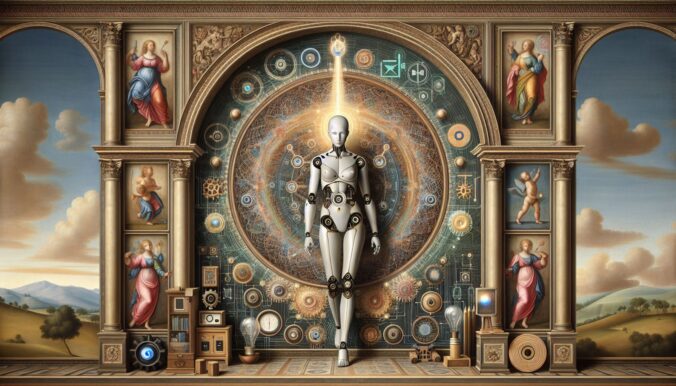
Hey tech aficionados and curious minds! I’m absolutely stoked to talk about a topic that’s been swirling around tech debates for some time now: Artificial Intelligence in creative arts. Seriously, if you thought AI was just about sorting your photo gallery or curating your playlist, brace yourself. We’re seeing something completely new here, and it’s powered by lines of code.
The Rise of AI Artists
Picture this: Algorithms creating incredible pieces of art, crafting compositions that are hard to tell apart from those of human maestros. It’s not just science fiction anymore. From abstract paintings to Grammy-nominated tracks, AI is mixing creativity with computation. Companies like OpenAI, known for their GPT magic, and startups like Runway ML are pushing these boundaries. Remember when AI-generated art by Obvious sold for $432,500 at Christie’s auction? Yeah, that’s just the beginning.
I remember the first time I saw an AI-generated artwork. It was like a modern Picasso hammered out by machine circuitry. At first, I couldn’t help the skepticism. Was it really art? But as I looked deeper, it wasn’t just the wild swirls or the strange depth that caught my eye. It was the story, the process behind each piece.
A Peek Behind the Algorithmic Canvas
Now, let’s get into the geeky stuff that us tech heads thrive on. Most AI “artists” are neural networks trained with thousands, if not millions, of images, learning patterns, textures, colors, and emotions. Think of it like tossing every art history book you can find into a metaphorical blender.
Generative models, like GANs (Generative Adversarial Networks), are the real workhorses here. They work by having two neural networks duke it out. One network creates artworks while the other critiques, sort of like having an angel and a devil on AI’s shoulders, resulting in progressively smarter and aesthetically pleasing outputs. It’s the ultimate art school of the future!
Symphony of Silicon: AI in Music
If Gustav Mahler and Bit depth had a baby, it’d be AI music. Yeah, it’s that wild. We’re seeing applications where AI isn’t just accompanying musicians but is composing original scores. Companies like Amper Music are providing platforms for users to create full-fledged soundtracks for films, commercials, or even that podcast you thought you’d start… last year.
Some naysayers argue AI robs music of its soul. But having tinkered with a few AI music tools myself, I realized it’s not about replacing human emotion. It’s about enhancing what’s already there. AI can experiment with hundreds of musical patterns in the time it takes a human to find C minor. So, rather than dreading Skynet conducting our symphonies, we’re looking at a tool that complements human creativity.
The Ethical Palette: Who Owns AI Art?
Here’s the kicker: With AI art comes a whirlpool of legal and ethical dilemmas. If my machine churns out the next Louvre-worthy piece, can I put my signature on it? Some argue that creators of the algorithm hold the rights, others say it’s like trying to claim ownership over a sunrise. Natural but impossible to own. It’s an ongoing conversation with no clear legal framework yet.
The potential for misuse also lurks. Imagine AI replicating art styles and flooding markets with ‘knock-offs,’ harming emerging artists. Balancing innovation with integrity remains crucial.
Speculating the AI Muse: The Future?
As we peer into this hazy digital frontier, I see collaboration. AI won’t replace human creators but become co-pilots on the canvas of imagination. Picture AR glasses that let you paint in 3D space or AI tools that assist writers by suggesting plot twists perfect for holonovels (Star Trek reference, anyone?).
The future might also see AI art curators or critics. An algorithm could recommend artwork personalized to your taste or predict emerging art trends, redefining how we discover and appreciate art.
A Technological Matisse in Every Home?
For the dreamers among us who believe in technology’s transformative power, these AI-driven artistic landscapes could democratize creativity. Imagine platforms where anyone can create, regardless of their skill levels, powered by AI guides. This leveling of the playing field could be a game-changer for the art world.
Wrapping It Up
Combining creative arts with AI doesn’t come without its hurdles, but the potential for stimulating human creativity is unmatched. As I type this blog post, I think about how technology has this sneaky yet exciting way of weaving into our lives and creating new norms.
In this age of AI exploration, let’s embrace the tools that help create new forms of human expression. Whether painting digitally with neural brushes or harmonizing with silicon symphonies, AI’s role in creative arts is clearly a major part of where we’re heading. So, let’s keep our eyes open and our thinking caps ready. The next masterpiece might just be created by a couple of electric circuits and your own boundless imagination.